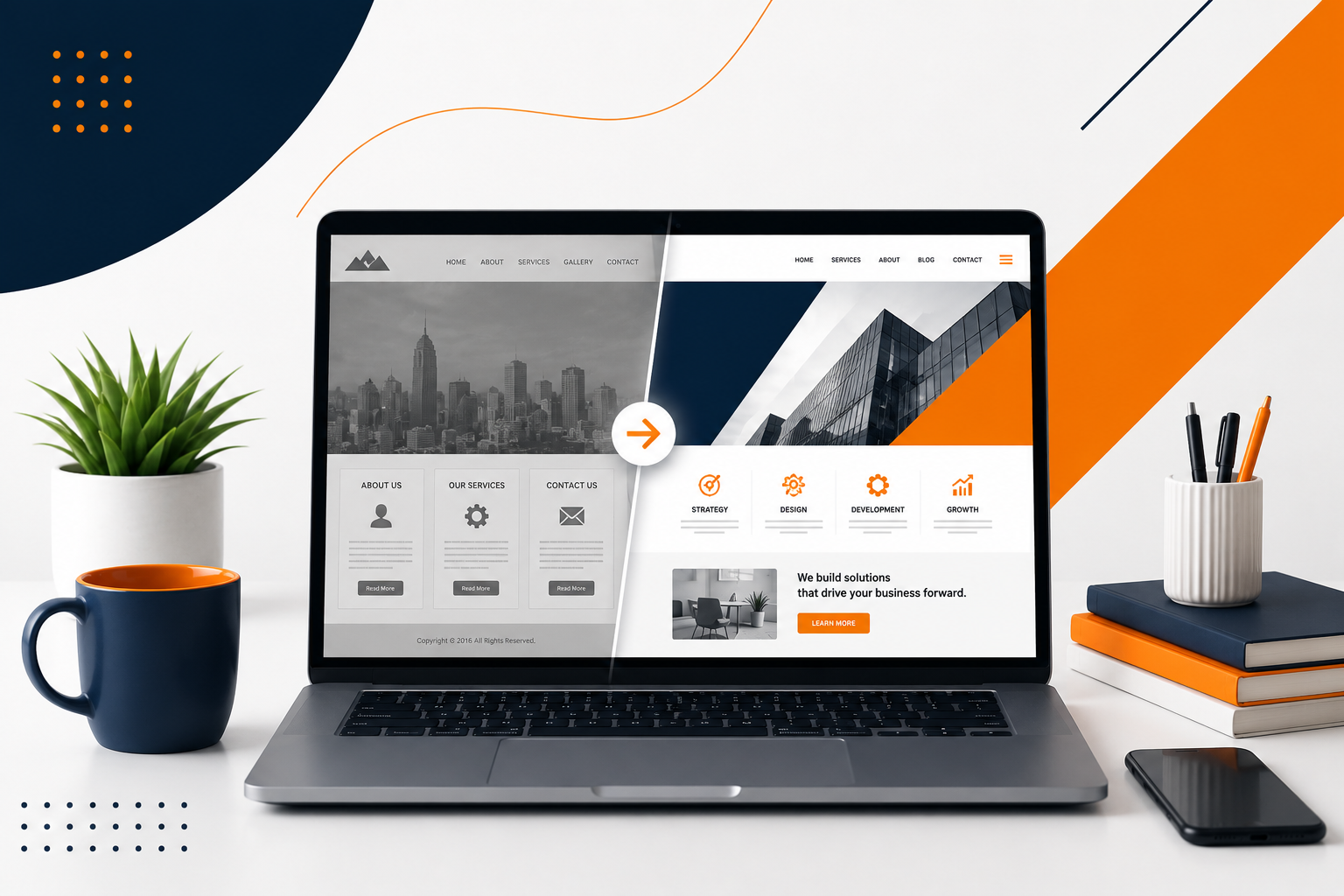
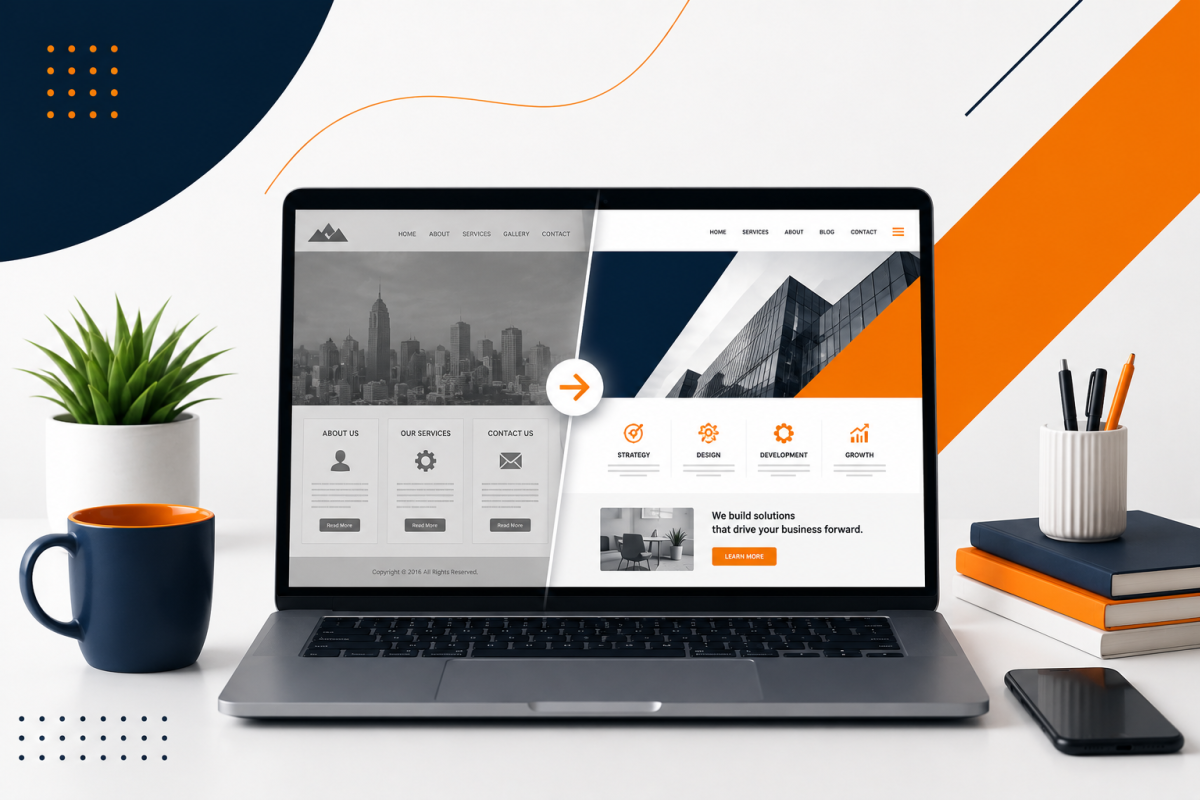
Your website may have looked great when it was first launched.
But websites age.
Technology changes. Customer expectations change. Your business changes. And a website that worked perfectly three or four years ago may no longer be helping your business today.
The problem is that an outdated website doesn’t always look obviously broken.
It may still load. Your pages may still be there. Your contact form might still work.
But the more important question is:
Is your website still helping your business grow?
Here are seven signs that it may be time to rethink your website.
1. Your Website Looks Outdated
- Crowded pages
- Small or difficult-to-read text
- Too many colors or competing elements
- Old-fashioned layouts
- Low-quality images
- Inconsistent fonts and buttons
- Large blocks of information with no clear hierarchy
2. It Doesn't Work Well on Mobile
Open your website on your phone.
Don’t just look at the homepage. Try actually using it.
Navigate through the menu.
Read a few pages.
Tap the buttons.
Fill out the contact form.
If you have to zoom in, scroll sideways, struggle to tap buttons, or wait for oversized images to load, your visitors are probably experiencing the same frustration.
A mobile-friendly website is no longer optional.
Many potential customers will discover and visit your business entirely from their phones.
Your website should adapt naturally to different screen sizes and make it easy for visitors to find what they need—whether they’re using a desktop computer, tablet, or smartphone.
3. Your Website Is Slow
- Oversized images
- Too many plugins
- Poor-quality hosting
- Unnecessary scripts
- Old website technology
- Poorly optimized pages
4. Visitors Can't Easily Find What They Need
A visitor shouldn’t have to understand your company structure to navigate your website.
They usually arrive with a simple goal.
They want to know what you offer.
They want pricing or more information.
They want to see your previous work.
They want to know whether you can solve their problem.
Or they simply want to contact you.
Your website should make those actions easy.
If your navigation contains too many choices, important information is buried several pages deep, or visitors don’t know what to click next, the website may need restructuring.
Good website design isn’t only about appearance.
It’s about helping people move naturally from:
“What is this business?”
to
“This might be what I need.”
to
“How do I get started?”
5. Your Business Has Changed but Your Website Hasn't
Businesses evolve.
Maybe you’ve added new services.
Perhaps you’ve stopped offering something.
Your target customers may have changed.
Your team may have grown.
Your branding may have been updated.
Or perhaps your business has simply become much better at what it does.
But does your website reflect that?
An outdated website can accidentally present an older version of your business.
Review your website and ask:
If someone knew nothing about our business and only saw this website, would they understand who we are today?
If the answer is no, it may be time for an update—or a redesign.
6. Your Website Gets Visitors but Not Enough Inquiries
- Requesting a quote
- Booking a consultation
- Calling your business
- Sending an inquiry
- Purchasing a product
- Downloading a resource
- Signing up for something
7. You're Embarrassed to Share Your Website
This one is surprisingly useful.
Imagine you’re speaking with a potential customer and they ask:
“Do you have a website?”
How do you feel about giving them the link?
If your first thought is:
“Yes, but we’re planning to update it…”
or
“Please ignore the homepage…”
or
“Most of the information isn’t updated yet…”
that’s a sign.
Your website should be something you’re comfortable putting on your business card, email signature, social media profile, proposal, or advertisement.
It represents your business even when you’re not there to explain it.
Does Having One of These Problems Mean You Need a New Website?
Not necessarily.
Sometimes a website doesn’t need a complete rebuild.
A few targeted improvements may be enough.
You might need to:
- Improve mobile responsiveness
- Optimize images and performance
- Simplify navigation
- Rewrite outdated content
- Add stronger calls to action
- Refresh the visual design
- Improve your contact or inquiry process
The important thing is to identify what isn’t working before deciding what technology to replace.
A redesign should solve problems—not simply make the website look newer.
What Should a Modern Business Website Do?
A good business website should do more than look professional.
It should help visitors understand your business and take action.
At minimum, it should:
Communicate clearly.
Visitors should quickly understand who you are and what you offer.
Work across devices.
The experience should be comfortable on desktop, tablet, and mobile.
Load quickly.
Visitors shouldn’t have to wait unnecessarily.
Build trust.
Your website should make your business feel credible and established.
Guide visitors.
Important pages and actions should be easy to find.
Support your business goals.
Whether your goal is inquiries, bookings, sales, downloads, or leads, your website should help move visitors toward it.
Most importantly, your website should be designed around the people using it—not just the people who built it.
Don't Redesign Just for the Sake of Redesigning
It’s easy to look at a competitor’s beautiful new website and think:
“We need one of those.”
Maybe you do.
But before redesigning, ask a better question:
What problem are we trying to solve?
Maybe customers can’t find important information.
Maybe your website isn’t generating inquiries.
Maybe it doesn’t work properly on mobile.
Maybe updating content has become difficult.
Maybe the design no longer represents your brand.
Understanding the problem first leads to better decisions about design and technology.
Your Website Should Grow With Your Business
A website isn’t simply an online brochure.
For many businesses, it’s part of the customer journey.
Someone discovers you.
They visit your website.
They learn about your services.
They decide whether they trust you.
And eventually, they decide whether to contact you.
That’s why your website shouldn’t simply exist.
It should have a job to do.
At Nuna Digital, we believe websites should be practical, purposeful, and built around real business needs.
Whether that means improving an existing website or building something new, the goal should always be the same:
Create a better experience for your customers while helping your business move forward.
Is your current website still doing its job?
It might be time to take another look.